One of the most common causes of chronic liver disease in the UK is MASLD. This stands for metabolic dysfunction‑associated steatotic liver disease. It was previously known as non-alcoholic fatty liver disease or NAFLD.
MASLD is closely linked to obesity and type 2 diabetes and can lead to fibrosis, cirrhosis, and liver cancer.
MASLD affects several organs and systems. This includes the liver, gut, fat tissue, pancreas, and immune system. Having so many things involved makes the condition difficult to study. This is one reason for the lack of effective, widely approved treatments.
What is the MIMIC project?
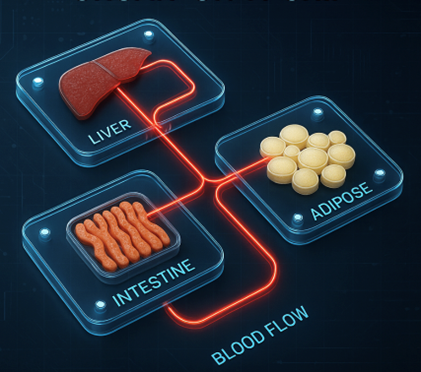
MIMIC is a UK‑wide programme to improve MASLD research. The platform uses human cells from people affected by MASLD. Instead of looking at just the liver, these cells are used to create small models of organs. Such as the liver, gut, fat tissue, and parts of the immune system. These models are connected through fluid channels. This means that hormones, nutrients, and inflammatory signals can move between them.
The platform recreates the main features of fatty liver in the laboratory. Including liver scarring and metabolic dysfunction. Researchers can also see how organs communicate during metabolic disease.
The work aims to include cells from donors with different ethnic backgrounds. This could help researchers learn how ethnicity affects who gets a condition. And how it develops.
The work is funded by the Medical Research Council, Wellcome Trust and the Innovate UK (UKRI3162).
Replacing animal testing
In 2025, the UK government announced a plan to cut down on and replace animal testing. In the United States, animal testing is no longer automatically required before trials of new medicines. Both countries are encouraging the use of human‑relevant models, like MIMC, instead. This strengthens the project’s relevance for future drug development.
Laboratory models can’t yet capture all the complexity and variety in real patients. And they cannot fully reproduce long-term disease processes. But MIMIC is an important part of the move toward more accurate, human‑focused science.
Who could benefit from this research?
This work is relevant to:
- people living with MASLD
- people with obesity or type 2 diabetes
- people with ongoing liver scarring, including fibrosis and cirrhosis
In the longer term, research may also help to reduce liver cancer risk in people with metabolic liver disease.
What could this mean for people with MASLD?
MASLD involves several organs. So treatments that target only the liver often have limited success. By recreating MASLD in a multiorgan system, MIMIC helps researchers:
- understand why the disease gets worse in some people but not others
- learn how someone’s genes could influence how liver scarring progresses
- study inflammation, metabolism, and scarring in combination
- study how processes such as insulin resistance or gut inflammation cause liver injury
- test new treatments in a more realistic way in the laboratory, before they reach clinical trials
This increases the likelihood that future medicines will be safer and more effective.
Several scientific discoveries made in animal models do not replicate when tested in humans. Where possible starting or using human relevant methods will reduce such a gap in translation.
-Prof Aithal
How will the research be tested?
Researchers will test the platform to see how well it predicts human responses. They will compare results from the platform with patient data. This will make sure it accurately reflects real-life with MASLD. They will also use medicines with known effects to test the platform.
MIMIC will be tested and improved over time. It will also be linked to clinical data. This will make it more reliable. And more useful for developing new MASLD treatments.
Where and when is this research taking place?
The project is led by Professor Amir Ghaemmaghami from the University of Nottingham. It involves several UK and US institutions (Universities of Nottingham, Edinburgh, Southampton, Harvard, Quadram Institute and Medicines Discovery Catapult). As well as NHS‑linked centres (NIHR Nottingham Biomedical Research Centre).
These bring together experts in:
- liver disease (Profs Guruprasad Aithal and Prakash Ramchandran)
- metabolism (Profs Jaswinder Sethi and Naiara Beraza)
- immunology (Prof Amir Ghaemmaghami)
- bioengineering (Profs Shrike Zhang and Alvaro Mata).
MIMIC is ongoing, with findings expected over the next few years.
When might this make a difference for people with MASLD?
Some benefits, like improved safety testing for medications, may show up in 4 to 5 years. Larger impacts on day‑to‑day treatment will take longer.
But MIMIC lays an important foundation. In the future it could lead to faster and more accurate development of treatments for MASLD.
Find out more about: